
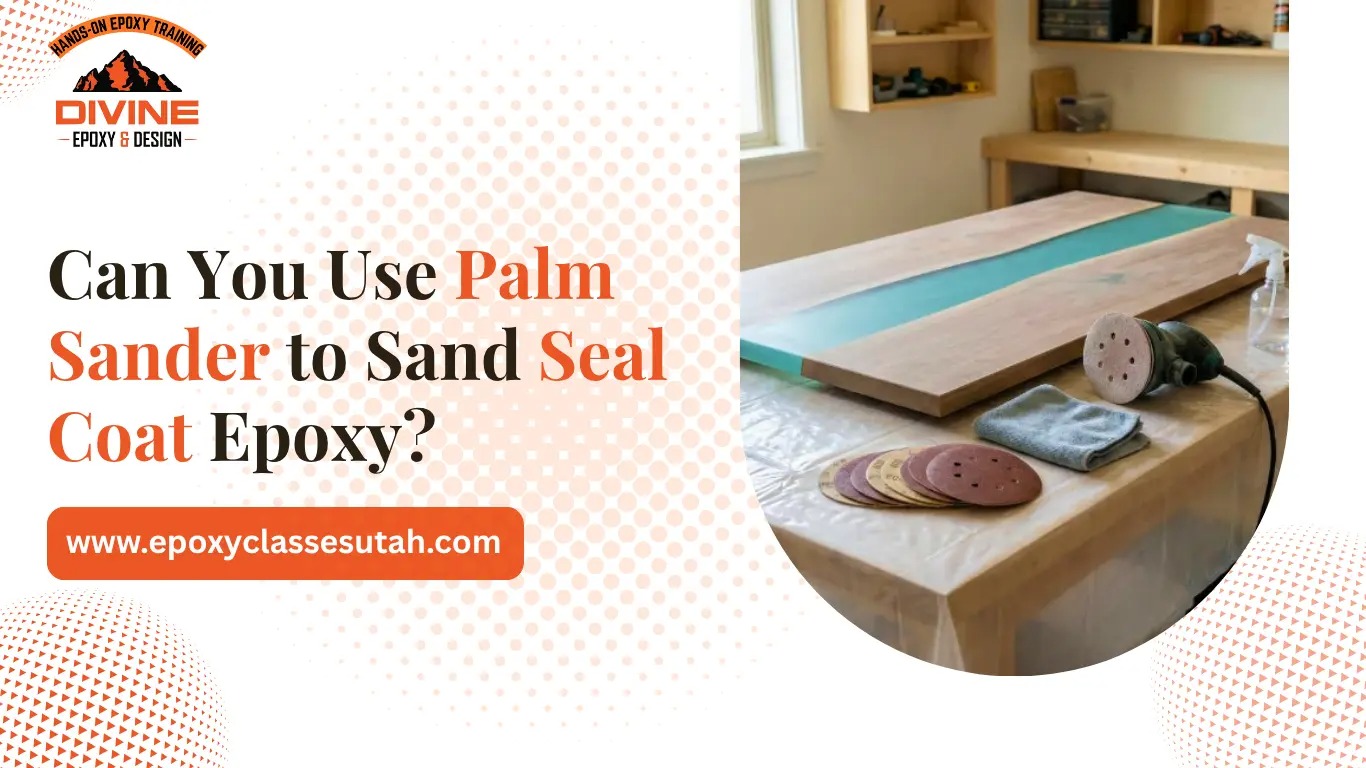
Can You Use a Palm Sander to Sand Seal Coat Epoxy?
Most epoxy projects don’t fail during the pour; they fail during the finishing stage where precision actually matters.
The real question you should be asking is simple and direct. Can you use palm sander to sand seal coat epoxy?
Yes, you can and when you use it right, it’s one of the fastest ways to get a smooth, professional-grade finish. But understand this clearly before you start. The tool itself does not determine the outcome; your execution does.
This is not theory. This is a system that works.
Follow it step by step and you will master sanding epoxy resin with precision, pick the exact sandpaper for epoxy resin at every stage, and execute how to polish epoxy after sanding to get a clean, mirror-level finish that actually looks professional.
No guessing. No wasted time. Just results.
And if you want to speed up the learning curve and skip costly mistakes, training from Epoxy Classes Utah gives you real-world reps so you can build skill faster and get it right the first time.
Can You Use Palm Sander to Sand Seal Coat Epoxy?
Let’s keep it simple.
Yes, you can use a sander to sand seal coat epoxy.
In fact, it’s one of the best tools for:
Even sanding
Better control
Faster results compared to hand sanding
But here’s the catch…A palm sander can also:
Burn the epoxy
Leave swirl marks
Create uneven surfaces
If you don’t control pressure, speed, and movement, you’ll damage the finish instead of improving it.
Can You Sand Epoxy Resin? (What You Must Know First)
Another common question: can you sand epoxy resin?
Yes but only after it fully cures. Once hardened, epoxy behaves like a hard plastic surface. That means:
Sanding removes surface defects with precision when the correct method is applied.
Polishing brings back full clarity and gives you a deep, high-gloss finish.
Refinishing adds durability and protects both the strength and look over time.
Now here’s something important:
Is sand rough?
Yes and that’s exactly why it works.
Sandpaper creates tiny scratches on the epoxy surface. These scratches:
Remove imperfections
Help new layers stick
Prepare for polishing
No scratches = no adhesion = poor finish.
Why Sanding and Polishing Epoxy Resin Is Critical?
Even a perfect pour isn’t perfect. You’ll still get:
- Air bubbles
- Ripples
- Uneven seal coat
That’s where sanding and polishing epoxy resin comes in. Sanding does two things:
Fixes flaws
Prepares the surface for finishing epoxy
If you skip sanding:
New coats won’t bond properly
You’ll see cloudy or dull spots
The finish won’t last
Polishing then removes those sanding marks and restores clarity.
What Grit Sandpaper for Epoxy Resin?
This is where most people mess up. Using the wrong grit ruins the finish.
Grit Breakdown
120–150 grit → Leveling (removing bumps, defects)
220–320 grit → Seal coat sanding
400–800 grit → Smoothing (pre-polish)
1000–3000 grit → Fine finishing
If you’re wondering what grit to sand seal coat, the answer is:
220–320 grit
It creates enough texture for adhesion without leaving deep scratches.
How to Choose the Right Sandpaper?
It depends on surface condition and stage of your project
Rough surface? Start course.
smooth surface? Start finer.
Common Mistakes
- Starting too fine → wastes time
- Skipping grits → leaves visible scratches
- Using worn sandpaper → creates heat and damage
Step-by-Step Guide: Sanding Epoxy Resin with a Palm Sander
This is the process that separates amateurs from pros.
Step 1 – Let Epoxy Fully Cure
Wait 48–72 hours.
If you sand too early:
The resin gums up and surface gets ruined
Step 2 – Inspect the Surface
Look for:
Bubbles
High spots
Burn marks
If you’re dealing with damage and wondering how to sand down burnt epoxy on table:
Start with 120–150 grit, then refine.
Step 3 – Start Sanding
Use:
120–220 grit depending on defects
Technique:
Keep the sander flat
Use light pressure
Let the tool do the work
Stay moving, never sit in one spot.
Step 4 – Smooth the Surface
Move to:
220–320 grit
This removes scratches from earlier sanding.
Step 5 – Wet Sanding
Now you level up.
Use:
400–800 grit + water
Benefits:
Less heat
Better finish
Cleaner surface
Step 6 – Sanding and Buffing Epoxy Resin
Switch from sanding to finishing:
Use polishing pads
Prepare for sanding and buffing epoxy resin
How to Polish Epoxy After Sanding? (Mirror Finish Guide)
This is where the magic happens. To how to polish epoxy after sanding:
Use:
Foam or microfiber pads
Polishing compounds
Technique:
Slow circular motion
Keep moving
Avoid heat buildup
The goal? Turn a dull surface into a clear, reflective finish. You can also explore polishing compounds here:
Pro Tips for Sanding Epoxy with a Palm Sander
Keep the sander flat, don’t press hard
move in overlapping passes and replace sandpaper often, also control heat at all times
These small details create big results.
Common Problems When Sanding Epoxy (And Fixes)
Epoxy Feels Rough After Sanding
Normal.
Fix:
Move to finer grit
Polish properly
Burn Marks or Soft Spots
Cause:
Too much heat
Fix:
Re-sand with lower grit
Swirl Marks
Cause:
Poor movement
Fix:
Use higher grit
Sand evenly
Re-Sanding Epoxy
re-sanding is needed when:
Fixing mistakes
Applying new coat
Sanding Epoxy Floor vs Table – What’s Different?
sanding epoxy floor → need larger sanders
Tables & countertops → palm sander works best
Same grit rules. Different tools.
What to Use for the Bottom of an Epoxy Desktop?
Don’t overthink it.
Use:
320–400 grit
A matte finish is enough. what to use for the bottom of an epoxy desktop is simple: No need to polish what no one sees.
Palm Sander for Polishing Epoxy – Does It Work?
Yes.
A palm sander for polishing epoxy can double as an epoxy sander and polisher if you use:
Foam pads
Polishing compounds
For bigger jobs, dedicated polishers are better.
Safety Tips for Epoxy Sanding
Don’t ignore this.
- Wear a dust mask
- Use gloves
- Wear long sleeves (do you need long sleeves to sand cured epoxy → yes)
- Work in a ventilated area
Epoxy dust is not something you want in your lungs.
Best Tools for Epoxy Sanding and Polishing
- Palm sander
- Orbital sander
- Hand sanding blocks
- Polishing machines
If you’re wondering what are some good polishers for epoxy resin, dual-action polishers and variable-speed buffers are top choices.
Use the right tool for the job and the job becomes easier.
Final Tips for Finishing Epoxy Like a Pro
- Follow the full grit progression
- Don’t skip steps
- Be patient
- Control heat and pressure
This is not about speed. It’s about precision.
Conclusion
So—can you use palm sander to sand seal coat epoxy?
Yes. And when done right, it’s one of the most effective ways to get a smooth, professional finish.
But remember:
It’s not about the tool.
It’s about:
Grit progression
Technique
Control
Master those, and your epoxy won’t just look good.
It’ll look like glass.

No comment